How do you remember something you have learned?
Can you remember where the bread is in the supermarket? Can you create a map in your head of how to get there or were you told instructions on the first visit? Was it easier when you were given a map of the aisles with the bread section highlighted in green?
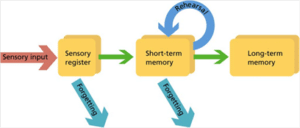 If you can picture where it is, and how it was highlighted in green, you are using your visual spatial memory. Compared to listening to 10 instructions, where you used your auditory memory. Chances are you were more successful with remembering the green highlighter (visual).
When we learn information, our brain needs an easy way to move it from our short-term memory into long-term memory. This is usually done with Rehearsal i.e. repetitive exposure with different sensory approaches (auditory, visual, physical etc.).
Impact of Down Syndrome
 For children with Down Syndrome (DS) remembering what they have learnt can be difficult.
The phonological loop is a part of the memory system involving the ability to hold information that you have just heard. Children with DS have an impaired phonological loop, causing difficulty to remember something they have been told or even how it sounded.
Hearing loss can also coincide with this, further impacting on how they can listen to and receive auditory information.
Visual short term memory is stronger in DS children, where they are better able to process visual components of information on a visuospatial sketchpad and into their working memory.
Therefore, to increase a child’s learning it is helpful to use visual supports such as:
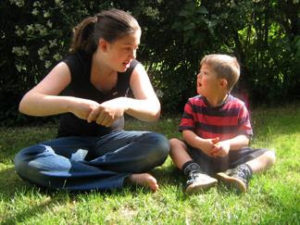
Makaton (signing)
Core Communication Boards
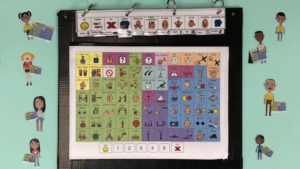
Picture/photo books
(name/talk about things in the pictures)
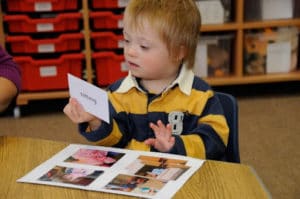
Visual schedules (explain activities/places)
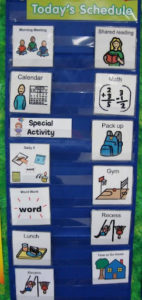
Visual supports are a visual physical stimulus that a child can look at for a longer period of time where they can then create a more permanent snapshot in their visuospatial sketchpad to help process the information from the short-term to the long term memory.
When interacting with a child with DS, think of how you can be adding a visual component to what they are learning e.g. use your arms and hands to emphasize the difference between a big bubble and a little bubble.
Make sure you do not completely remove the auditory component of communicating as it requires more than one way to learn and remember something. Just like when you used the highlighted map, aisle signs and listened to instructions to successfully find the bread at the supermarket.
Written By:
Lacie Glen Vile
Speech Language Therapist